
The short version
Brachycephalic obstructive airway syndrome (BOAS) is a group of airway problems in flat-faced dogs and cats. Their skulls are short, but the soft tissues inside the nose and throat are not shortened to match, so air has trouble getting through.
- It is common in flat-faced breeds such as English and French Bulldogs, Pugs, Boston Terriers, Boxers, Shih Tzus and Pekingese. Persian, Himalayan and Exotic Shorthair cats can be affected too.
- Clinical signs are often dismissed as normal for the breed: loud snoring and snorting, noisy breathing, tiring quickly on walks, gagging, and retching or vomiting.
- Pinched nostrils and a long soft palate are the usual starting problems. Over time, the strain of breathing can damage the voice box (larynx) and make everything worse.
- Heat and exertion can become an emergency. Blue or gray gums, collapse, or struggling to breathe need immediate veterinary care.
- Surgery can widen the airway. The most common procedures widen the nostrils and shorten the soft palate, and doing them early often gives the best results.
- Weight control, a harness and avoiding heat help every affected pet, with or without surgery.
This article is general education and does not replace an examination by your veterinarian. BOAS affects each pet differently, and the right plan depends on your pet’s exam and airway evaluation.
What is BOAS?
Brachycephalic means “short-headed.” Over generations, flat-faced breeds were bred for shorter and shorter noses, but the soft tissues inside the nose and throat did not shrink with the skull. The result is the same amount of tissue packed into much less room, which narrows the airway at several points.
Dr. Danova often describes it this way: Imagine a long-nosed collie with all of its internal structures smooshed into the face of a pug or a bulldog. That is what we are dealing with anatomically. Those tissues need somewhere to go and most often they expand into the airway causing obstruction.
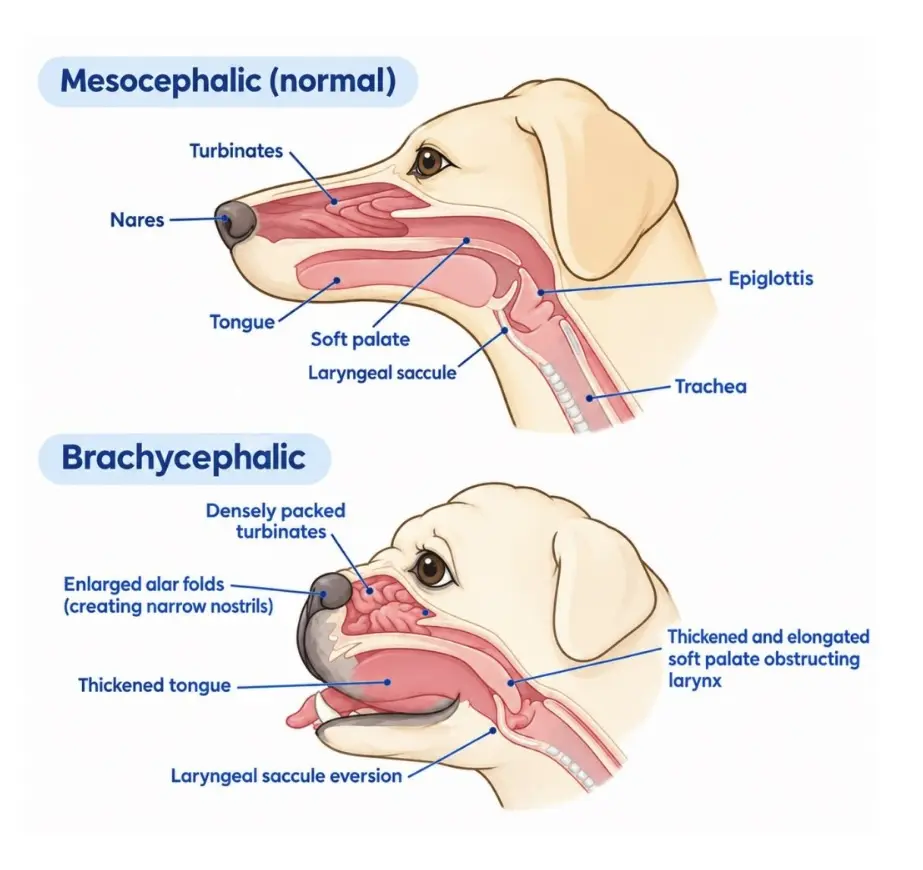
Because the airway is so narrow, your pet has to pull much harder to breathe in. That extra suction pulls the tissues of the throat inward and irritates them, so the problem gets worse over time. BOAS is usually described as primary changes, which a pet is born with, and secondary changes, which develop as a result of the strain.
| Primary changes (present from birth) | Secondary changes (develop over time) | |
| Nose | Stenotic nares: small, narrow nostrils that may collapse inward when your pet breathes in | Narrowed nasal passages with crowded tissue inside the nose |
| Throat | Elongated soft palate: the flap at the back of the roof of the mouth hangs too long and blocks the entrance to the windpipe | Thickened, swollen soft palate, and enlarged tonsils |
| Voice box (larynx) | Normally shaped at birth | Everted laryngeal saccules: small pouches pulled inside out into the airway; in advanced cases the larynx can lose its firmness and collapse |
| Windpipe (trachea) | Hypoplastic trachea: a narrower than normal windpipe in some breeds | Not applicable |
| Stomach and intestines | Reflux, regurgitation and vomiting, which are common and often improve after airway surgery |
For the curious: Breathing is mostly the work of pulling air in. When the airway is narrow, the pressure inside the throat drops far lower than normal on each breath, and that suction is what draws the soft palate and the pouches of the voice box inward. This is why the secondary changes are considered a consequence of the primary ones, and why correcting the primary problems early may help prevent the secondary ones.
Signs of BOAS and how severe it can be
Emergency: If your pet has blue, purple or gray gums or tongue, is struggling to breathe, collapses, or has been in the heat and is panting heavily and cannot settle, go to your veterinarian or an emergency hospital right away. Flat-faced pets cannot cool themselves well, and overheating can progress quickly.
Many families are told that noisy breathing is just part of owning a flat-faced pet. It is common, but it is not healthy. Clinical signs to watch for include:
- Loud snoring, snorting or noisy breathing, even when resting
- Open-mouth breathing, or panting at rest or with mild activity
- Tiring quickly on walks, or reluctance to exercise
- Gagging, retching, or coughing at the end of a meal or after drinking
- Regurgitating food or vomiting, especially after eating or exercising
- Sleeping with the head propped up, or sleeping poorly because of breathing effort
- Fainting or collapse after exercise, excitement or heat
- Gums or tongue that turn bluish
Severity runs from mild to life-threatening. Some pets only snore and snort but are otherwise comfortable. Others struggle to breathe during everyday activity, overheat easily, or collapse. Your veterinarian looks at your pet’s breathing effort at rest and after light exercise, along with the gum color, the shape of the nostrils and any signs from the digestive tract, to decide how severe it is.
Who is at risk?
- Flat-faced dogs, including English and French Bulldogs, Pugs, Boston Terriers, Boxers, Shih Tzus, Pekingese, Lhasa Apsos and Cavalier King Charles Spaniels
- Flat-faced cats, such as Persians, Himalayans and Exotic Shorthairs
- Pets that are overweight, since extra weight in the neck and throat makes breathing harder
- Young pets: the primary changes are present from birth, and signs often appear in the first few years of life
Hot, humid weather, excitement and exercise can trigger a crisis in an affected pet even if they usually seem fine.
How BOAS is diagnosed
The nostrils can be checked at a routine exam, and your veterinarian will listen to your pet’s breathing and look at the gums, weight and body condition. Seeing the soft palate and the voice box requires a short anesthetic with very specific medications to allow normal breathing, because awake pets cannot hold the mouth open or relax enough for a full view.
The airway exam under anesthesia shows how long and thick the soft palate is, whether the tonsils are enlarged, and whether the laryngeal saccules are everted or the larynx is collapsing. Chest and neck radiographs are often taken to check the windpipe and lungs and to rule out other causes, such as pneumonia. When the exam is done just before surgery, any problems found can be corrected during the same anesthetic. Anesthesia in flat-faced pets carries extra risk, so it is done with careful airway planning and close monitoring.
Treatment: management and surgery
Non-surgical management helps every affected pet and may be enough for a mild case:
- Keep your pet at a lean, healthy weight
- Use a harness instead of a collar so there is no pressure on the neck
- Avoid heat, humidity and strenuous exercise, and never leave your pet in a parked car
- Keep your pet calm and cool when they are excited, and offer shade and water
- Ask your veterinarian about treating reflux or digestive signs if they are present
Surgery is considered when your pet’s breathing is noisy and labored with everyday activity, or when there are signs of collapse, overheating or severe digestive upset. The goal is to open the airway so your pet breathes with less effort. Surgery cannot change the shape of the skull, so it improves the airway rather than making your pet breathe like a long-nosed breed.
| Procedure | What it does | Where it is used |
| Nostril widening (rhinoplasty or alaplasty) | Removes a small wedge of tissue from the edge of each nostril so the opening stays wide when your pet breathes in | Stenotic nares; often done with the palate surgery |
| Soft palate shortening (staphylectomy or palatoplasty) | Shortens, and in some techniques thins, the soft palate so it no longer blocks the entrance to the windpipe | Elongated or thickened soft palate |
| Removal of everted laryngeal saccules (sacculectomy) | Removes the pouches that have been pulled into the airway | Older or more severely affected pets |
| Tonsil removal | Removes tonsils that have become enlarged enough to block the airway | Only when the tonsils are obstructing |
For the curious: Many pets have more than one of these problems at once, so it is common for the nostrils and palate to be corrected in the same anesthetic. Correcting them early may reduce the secondary changes in the larynx later on, which is one reason surgery in young pets with clear signs tends to work well.
Recovery and outlook
Most pets breathe more easily after surgery, and many also have fewer digestive problems. The airway tissues can swell after surgery, especially the soft palate, so close observation is important in the first days. Your veterinary team will watch your pet’s breathing carefully and give medication to control swelling and discomfort.
After surgery, expect:
- Calm, cool, quiet rest at home, with no hard exercise or rough play until your veterinarian clears it
- A soft or moistened diet for a short time, as directed by your veterinarian
- A harness only, with no collar pressure on the neck
- A watchful eye on breathing. Contact your veterinarian right away if breathing becomes noisy or labored, the gums look blue, or your pet cannot settle
- Recheck visits so your veterinarian can confirm healing
Surgery improves breathing but does not cure the breed’s tendency to overheat, so the lifestyle precautions above continue for life. If your pet is overweight, weight loss is one of the most effective ways to help their airway, before or after surgery.
Frequently asked questions
Why does my French Bulldog snore and snort so much?
The nostrils are narrow and the soft palate is usually too long, so air has to squeeze past tissue that vibrates and blocks the airway. It is very common in flat-faced breeds, but it is a sign of extra breathing effort, not a normal feature.
Is it normal for a pug to breathe loudly?
Loud breathing is common in pugs, but it means the airway is narrowed. Mild noise may be manageable, while labored breathing, tiring quickly, or fainting needs a veterinary evaluation.
My flat-faced dog is gagging and vomiting. Could it be BOAS?
Yes. Many pets with BOAS also have reflux and regurgitation because of the extra pressure changes in the chest and throat. These digestive signs often improve when the airway is corrected.
When is the best age for BOAS surgery?
Your veterinarian will advise you, but surgery is often most helpful when it is done before the secondary changes in the throat develop. Many pets are evaluated as young adults, or earlier if their signs are significant.
How do I keep my flat-faced dog cool?
Avoid midday heat and humidity, offer shade and water, keep exercise gentle, use a harness, and never leave your dog in a parked car. If your dog is panting heavily and cannot settle, treat it as an emergency.
Do cats with flat faces need BOAS surgery too?
Some do. Cats such as Persians and Himalayans can have narrow nostrils and other airway problems, though many are affected less severely than dogs. Your veterinarian can tell you whether your cat would benefit from an airway evaluation.
How much does BOAS surgery cost?
Cost depends on which procedures your pet needs and your pet’s individual circumstances. Ask your veterinarian for an estimate that includes the airway exam, surgery, monitoring and follow-up.
How Veterinary Surgical Options (VSO) can help
VSO is a mobile surgical referral service: Dr. Danova comes to your veterinarian’s hospital to perform your pet’s surgery there. Your regular veterinarian stays involved in your pet’s care.
Because surgery is performed on-site at your veterinarian’s hospital, you avoid additional travel, a separate intake process, and an unfamiliar environment, and it helps reduce the cost to you.
If your pet is struggling to breathe, call your veterinarian first. They can stabilize your pet and tell you which care is the fastest route to the right treatment.